
Urban Sprawl
Updated: Sep 11
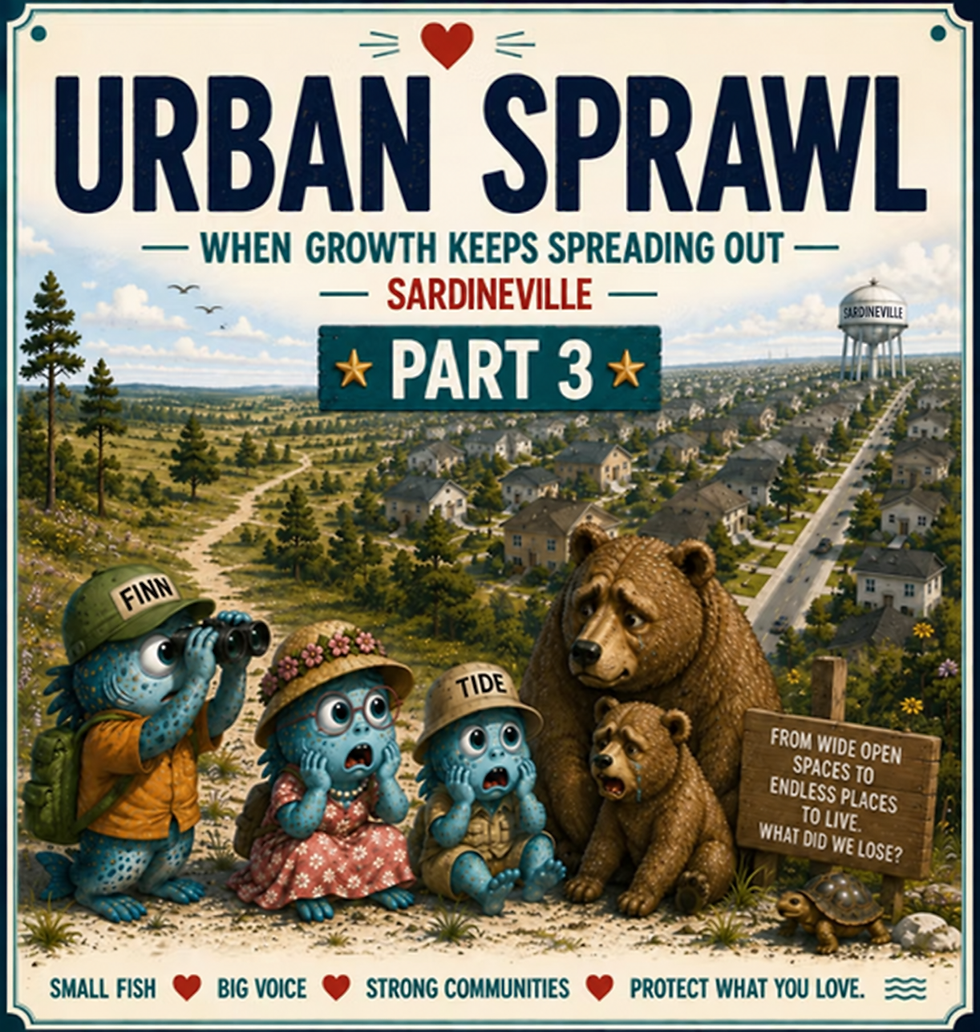
When Growth Keeps Spreading Out
Part Three of the Understanding Urbanization Series
By now, we know that urbanization describes the way communities grow and change over time. But growth does not always happen in the same way.
One pattern is known as urban sprawl—development that spreads outward from existing communities, often into areas that were previously rural or undeveloped.
Picture a small community bordered by longleaf pines, wildlife habitat, and quiet country roads. A new neighborhood appears beyond the old edge of town. More development follows. Businesses move outward to serve the growing population, and roads and utilities extend with them.
Twenty or thirty years later, the edge of town may be miles from where people once thought it was.
That change did not happen overnight. It happened one decision, one road, and one development at a time.
Growth Has a Footprint
As development spreads outward, communities must consider how roads, water and sewer systems, schools, emergency services, and other public infrastructure will serve a larger geographic area.
The land changes, too. Forests and other undeveloped areas may be converted to residential or commercial uses, and wildlife habitat can become smaller or fragmented.
None of that automatically means a particular development is bad. It does mean that where growth occurs matters just as much as how much growth occurs.
When the Change Becomes Visible
For people who have lived in the same community for decades, the change can be striking. Places once considered the edge of town become surrounded by development. Roads that once served relatively small populations carry more traffic, while homes and businesses extend farther into areas that were previously rural or undeveloped.
The transformation rarely happens all at once. It happens gradually, as individual development decisions accumulate over time.
That is one reason urban sprawl can be difficult to recognize while it is happening. Each individual project may represent only a small piece of the landscape. Years later, those pieces can look very different when viewed together.
The Question Is Not “Growth or No Growth?”
Urban sprawl is not merely a question of whether a community is growing. The pattern of that growth matters.
Are new homes being built where roads and utilities can accommodate them? What happens to transportation as development moves farther outward? What natural areas are being converted or fragmented? Are infrastructure investments keeping pace with the development they are expected to serve?
Those are questions citizens can ask without assuming that every new development is harmful—or that every new development is progress.
Good civic participation requires something harder than choosing a side. It requires paying attention.
And Now We Need a Sardine Word
In the next lesson, we're going to introduce a word of our own:
Sardinization™.
It is the Life of a Sardine term for what happens when relentless growth begins crowding out the qualities that made people love a community in the first place.
Urbanization is the process. Urban sprawl is a pattern. Sardinization™ is what it can feel like when you're the sardine living through it.
And that is where this series gets interesting.
Protect What You Love.


Comments