
Why I Built Life of a Sardine
For several years, most of my attention was focused on caring for my mother. As her health declined, there were doctors, hospitals, medications, emergencies, and difficult decisions. There were also all the everyday responsibilities that do not disappear simply because someone you love needs you. My attention was where it needed to be: on my mother. While I was taking care of her, however, life outside my front door kept moving. Government meetings were held, property changed hands, and development applications moved forward. Decisions were being made about the future of the community where I lived, and I wasn't following most of them.
That wasn't because government or public policy were unfamiliar to me. Years earlier in Texas, I owned On Point Broadcasting and covered public-policy issues and government controversies. The Red Apple Project was among the stories I covered, and my work took me into other issues being debated across the state. I had also dealt with city, county, and state government through building projects. Asking questions, finding information, and trying to understand how government decisions affect people were not new to me.
What had changed was my life. Caring for my mother had taken me away from that world for several years, and I think that experience says something larger about citizenship. There are times when all of us are consumed by what is directly in front of us. It may be caring for a parent or raising children. A military family may be dealing with a deployment. Someone else may be building a business, working long hours or simply trying to pay the mortgage and get dinner on the table. While we are busy living, government continues operating and our communities continue changing.
When I began paying attention again, I wasn't starting from scratch. I was returning to something I had done before, but this time I was looking at it differently. Instead of covering a particular public-policy issue or working through the requirements of an individual building project, I began trying to understand how decisions made over many years fit together and what their combined effect could mean for an entire area.
Growth can bring things a community needs. People need places to live, businesses create jobs, and new development can bring opportunity. I don't find the old argument about being "for growth" or "against growth" particularly useful. I am more interested in what kind of growth a community can sustain without losing what made people want to live there in the first place. Land is finite. Water is not something we can take for granted. Roads have limits, infrastructure has to be maintained, and eventually somebody pays for what growth requires.
That question became very real for me because of approximately 40 wooded acres near my home. This wasn't an empty field waiting for somebody to find a use for it. It was wooded property with longleaf pines and wildlife habitat. As I began looking more closely at the environmental records for the property, I learned how much there was to understand about the animals that may use land like this and the surveys conducted before development. Some of what I found answered questions. Some of it raised new ones.
I know how close that wildlife is because I have seen it myself. I once watched a black bear cub attempt to cross Poquito Bayou Road. With traffic moving past, the cub turned around. Another time, I saw a large black bear sitting about forty feet from the edge of the woods near Lewis Turner Boulevard. He wasn't running across the road. He was sitting there looking at it. I drove to the next place where I could turn around and came back, and he was still there. Another car eventually pulled over to take a photograph, and the bear disappeared back toward the woods. I never forgot him.

The real Lewis Turner Bear, photographed near the woods along Lewis Turner Boulevard. This bear later became the inspiration for Lewis Turner Bear in Sardineville. — Photo by Laurie Bartlett
Today that bear has a home in Sardineville as Lewis Turner Bear. The woodpeckers and gopher tortoises have found their way into our little town too. They aren't random characters I chose because I needed animals for a cartoon. They came from the place around me and from questions I was already beginning to ask about what happens when development changes the habitat people and wildlife share.
Now those approximately 40 wooded acres near my home are being cleared, and I am watching it happen. As the trees come down, I find myself looking beyond the property lines. I wonder where the wildlife goes as habitat disappears and what happens when a bear reaches a busy road and turns around. I want to know whether connections between remaining habitat are considered as wooded areas become separated by development. I also want to understand what changes beneath our feet and around us when a large tract of trees is removed.


Clearing is underway on the approximately 40-acre property near my home. These photographs were taken as the wooded property was being cleared. — Photos by Laurie Bartlett
The questions do not stop with wildlife. There are limited ways in and out of this area, which raises questions about density and what additional development adds to roads that existing residents already use. Emergency access deserves attention too, particularly in a coastal area where hurricane evacuation is part of life. A development may be reviewed as an individual project, but the people living around it experience the combined result of everything that has been approved and built.
That is where my questions became larger than one development. I wanted to know who was looking at the whole picture. How do decisions about land connect with transportation? Where does local authority end and state authority begin? Who looks at the cumulative effect when one development follows another? I started following the paper trail.
One property could lead me into transportation records. A question about clearing could lead me toward environmental regulations. Before long, I was reading state law to understand why a local government could - or could not - do something. I began to see how easily we talk about "government" as though it were one thing, when in reality authority is divided among different levels of government and agencies.
Until you understand who does what, it can be difficult to know where to direct a question. Once you begin figuring that out, government starts looking different. A name on an agenda is no longer just a name. You understand why a particular board is discussing a project and what authority it has. You can begin tracing a decision rather than simply reacting to the result.
This is something I want us to learn together through Life of a Sardine. I don't want us to learn only what happened. I want us to understand how it happened. We are going to find the records and learn how to read them. When we encounter a government term that makes little sense outside the office that uses it, we'll figure out what it means. When a document raises another question, we'll follow it and see where it leads.
We also aren't going to begin with the answer we want and then search for evidence to support it. If something is established by the record, we'll say that. When we are drawing an inference, the reader should know it. Sometimes the records simply will not answer the question, and that needs to be said too. If additional evidence shows that something we believed was wrong, we'll correct it. The purpose isn't to prove ourselves right. The purpose is to be accurate. When I created Life of a Sardine, I established some boundaries for how we would do that work. We separate what the record establishes from what we infer, and we say plainly when a question remains unanswered. We do not allege wrongdoing or motive when the evidence does not establish it.
There Is a Reason We Have Trees
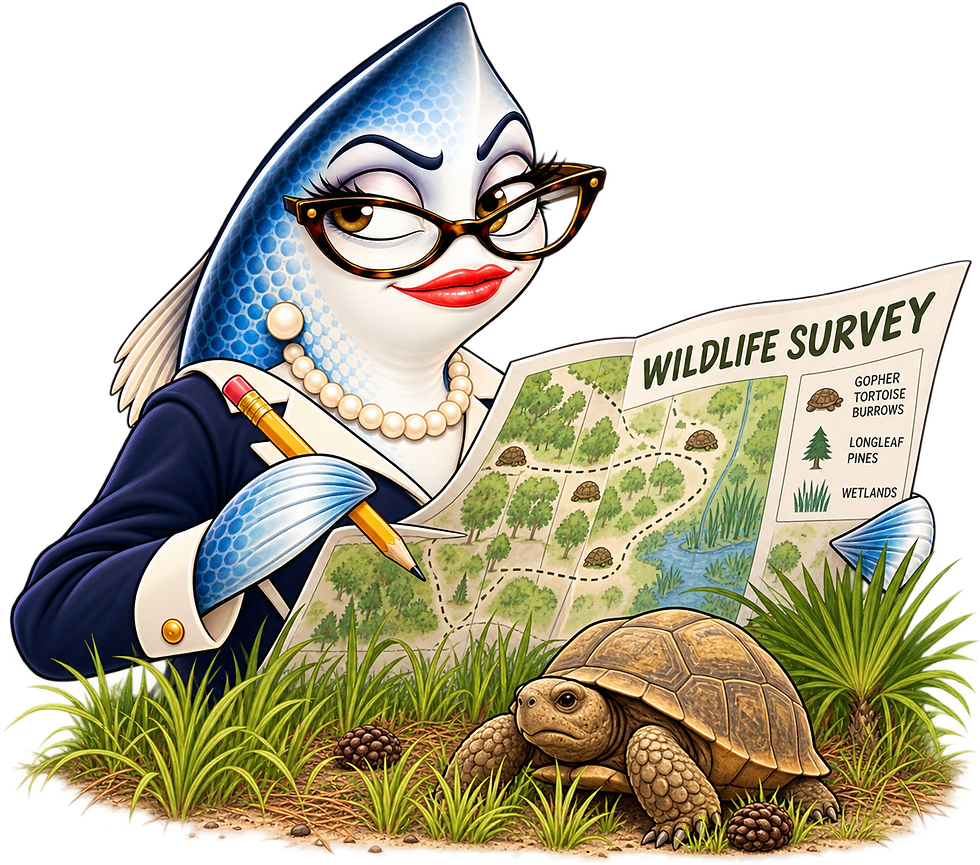
In the coming weeks, Life of a Sardine will spend more time looking at the wildlife that shares this part of Florida with us and at the natural resources that make this area what it is. Lewis Turner Bear will be back, and we will look closely at the wildlife surveys used during development. We will learn what those surveys actually found, what they could not determine, and why another survey may sometimes be required before land is disturbed. We will show you the records and let you see what they say for yourself.
We will also look at the land itself because there is a reason we have trees. They aren't simply something pretty left standing between subdivisions. I want to understand what they do for the land around them and what changes when wooded acreage is cleared. We will look at water and habitat, and at the effects of replacing natural ground with development, but I don't want to give readers conclusions before we've done the research. We'll find out, and we'll show you where the information came from.
And Then There Is Sardineville
Government documents aren't known for their entertainment value, which is one reason Sardineville exists. The cartoons give us a way to explain something complicated without turning every lesson into homework. Finn may have the question, Tide may go looking for an answer, and Bea may find something in a document that sends us in an entirely different direction. The Mackerels, of course, are quite capable of creating their own trouble.
Children can follow these stories, but Sardineville isn't only for children. Sometimes a cartoon can make an idea understandable long before a government definition does. We can use Sardineville School to explain a concept and Research & Ruckus when we want to dig deeper. We can visit the cafe, go to the Comedy Club or endure karaoke night. There is no rule saying citizens have to be miserable while learning how government works.
The humor does not change the standard behind the work. We still follow the record. Life of a Sardine isn't here to tell readers what to think. I would much rather teach someone where to look and let that person reach a conclusion after seeing the information.
This Isn't Just About My Town
Northwest Florida is where my questions begin because it is where I live and where I can watch change happening around me. Your community will be different, and your laws may be different too. Yet somewhere in your town, decisions are being made about what gets built and where. Other decisions affect the roads you use, the water you depend upon, or what land remains undeveloped.
Learning who makes those decisions changes the way you look at government. You begin to understand which questions belong at city hall or the county courthouse and which ones may lead to the state. You learn who was elected and who was appointed. More importantly, you begin to understand what authority those people actually have.
That knowledge also makes us better-informed voters. If we understand what an office controls, we can ask better questions of the people seeking it. We can look beyond a campaign advertisement and examine what happened while someone was in office. We can read the record ourselves. Life of a Sardine isn't going to tell you how to vote. I would much rather help you learn enough about your government to make that decision for yourself.
We Can Teach One Another
There are also people already doing important work inside their own communities. Here in Poquito Bayou, Dave Hensley and People Protecting Poquito Bayou have worked tirelessly to care for the community they call home and to get others involved. You will see some of that work here on Life of a Sardine through Dave’s Nuggets, where Dave shares what he has learned along the way. Every community has people who care enough to get involved. I want us to find them and learn from what they have experienced. What have they discovered? What has worked, and what hasn't? Their experience may give someone in another community a place to begin.
None of us can watch everything, and that may be one of the best reasons for building this community. If I figure out where to find a development application, I can show you. Someone who understands a traffic study better than I do may teach us what to look for. A reader somewhere else may discover that another community approached a similar problem differently, and that gives us something new to examine.
Expertise is welcome here, but curiosity is just as important. You don't have to agree with me, and I hope readers will challenge something if the evidence doesn't support it. Bring the document, and we'll look at it. Bring the kids along too. They are going to live with the decisions being made now, long after some of us are gone. They deserve to understand how those decisions were made.
Why You're Seeing Life of a Sardine Before It's Finished
Normally, I would have kept working until every page was finished and Sardineville was neatly put together before inviting everybody inside. I chose not to do that because the world I'm writing about isn't waiting for me to finish a website. Land is changing while I'm designing pages, applications are moving through the process while I'm drawing cartoons, and government meetings continue whether Sardineville is ready or not. Neither are the bulldozers waiting.
You'll see the town change as the website grows. New characters will appear and some ideas will probably get tossed back into the sardine can. You'll also see the research develop. A question may take us somewhere we didn't expect, and a document may change what we thought we knew. That isn't a problem with the project. It is part of the project.
There will be plenty of time to polish Sardineville, but there isn't unlimited time to pay attention. I started Life of a Sardine after looking up from several years of caring for someone I loved and realizing how much had changed while my attention was somewhere else. I'm paying attention again, and this time I'm inviting you to come with me.
My town is where the story begins. Your town is where you can use what we learn. Welcome to Life of a Sardine.
About the Author
Laurie Bartlett is an author, copywriter, longtime business owner, and founder of The Plumb Line Press and Life of a Sardine. Her background spans broadcasting, hospitality, and real estate, but the common thread has always been people, decisions, and the consequences that follow them. Writing under the pen name Anise Horvath, she is the author of Call Me to the River.
Comments